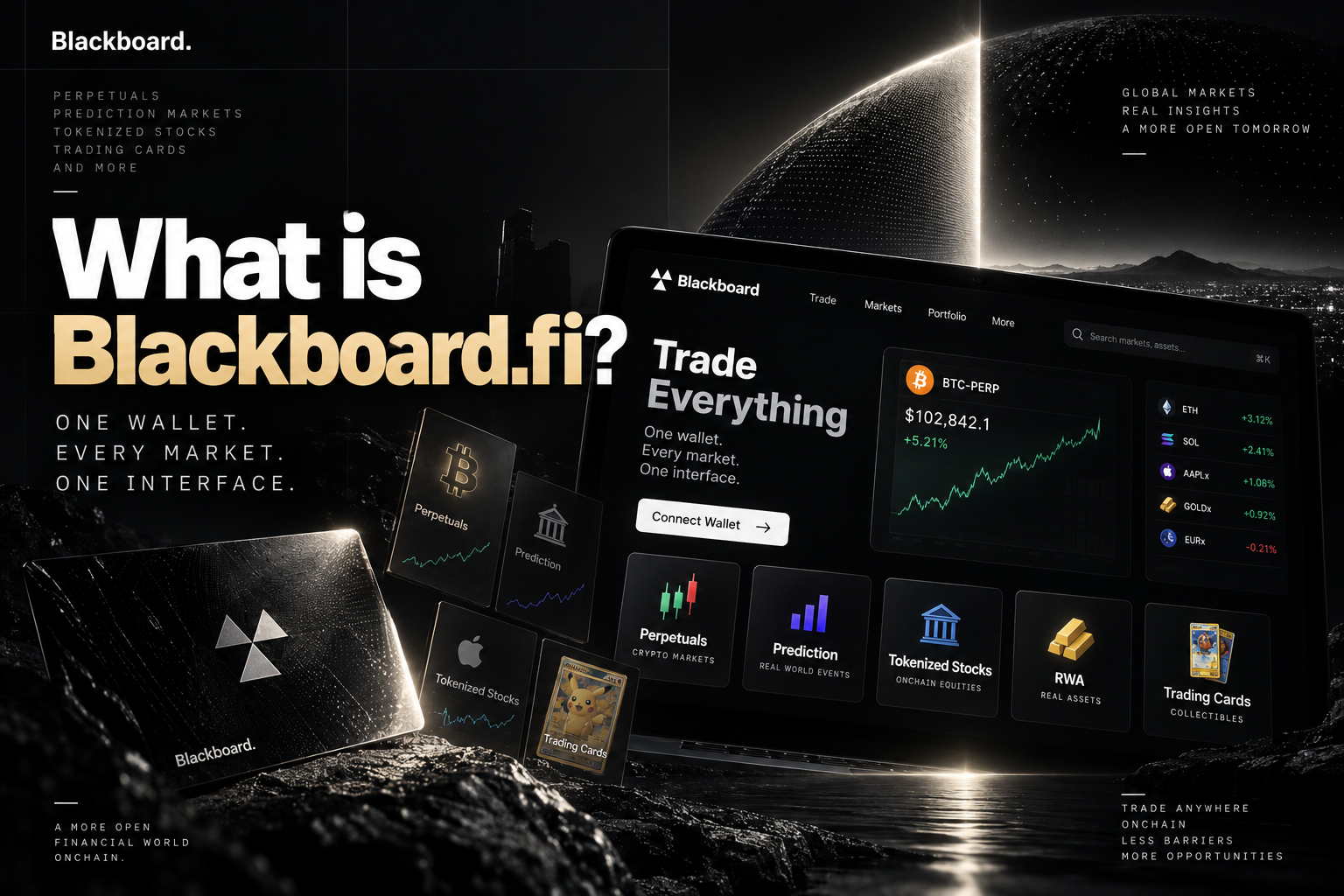
Blackboard.fi is a non-custodial onchain trading terminal designed to bring multiple crypto and financial markets into one interface.
Instead of moving between separate platforms for perpetuals, prediction markets, tokenized assets and other onchain products, Blackboard aims to provide a single gateway where traders can discover and access different markets.
Its core idea can be summarized simply:
One wallet. Every market. One interface.
So, what exactly is Blackboard.fi, how does it work, and what can you trade on it?
This guide explains the platform, its major markets and what makes Blackboard different from a traditional crypto exchange.
What Is Blackboard.fi?
Blackboard.fi is a non-custodial, multi-product onchain trading terminal.
Rather than operating as another traditional centralized crypto exchange, Blackboard is designed as an interface connecting traders with markets and liquidity that already exist across the onchain ecosystem.
This distinction is important.
Blackboard does not need to recreate every underlying market from scratch. Its broader strategy is to connect existing trading infrastructure and make those markets accessible through a unified interface.
For users, the goal is a simpler trading experience: fewer separate platforms, fewer fragmented balances and a single place to explore different types of onchain markets.
What Can You Trade on Blackboard.fi?
Blackboard is not limited to a single crypto market.
The platform currently presents several market categories, including Crypto Perpetuals, Prediction Markets, Up and Down, Tokenized Stocks and Trading Cards.
| Market | What It Offers |
|---|---|
| Crypto Perpetuals | Long and Short exposure to crypto markets |
| Prediction Markets | Markets based on real-world outcomes |
| Up and Down | Directional market products |
| Tokenized Stocks | Onchain access to tokenized stock-related markets |
| Trading Cards | Markets for tokenized collectible cards |
This multi-market approach is one of the main reasons Blackboard differs from a typical perpetual DEX.
Instead of building the entire platform around one type of trading product, Blackboard is positioning itself as a gateway to a broader range of onchain finance.
How Does Blackboard.fi Work?
Blackboard describes its approach as “We adopt, not rebuild.”
The idea is that strong protocols and liquidity venues already exist across crypto.
Rather than recreating those markets, Blackboard can sit above the underlying infrastructure and provide the interface through which users access them.
This makes Blackboard closer to an onchain trading gateway or brokerage interface than a conventional exchange that owns and operates every underlying market itself.
Why Was Blackboard Built?
Onchain trading has traditionally been fragmented.
A trader may use one platform for perpetual futures, another for prediction markets and another for tokenized assets.
Different chains can also introduce additional steps involving wallets, bridges, gas and separate balances.
Blackboard is designed around reducing that fragmentation.
Instead of forcing users to think about every piece of infrastructure separately, the platform aims to make the experience feel more like using a unified financial application.
That is the meaning behind Blackboard's positioning:
One wallet for every onchain market.
Blackboard.fi Crypto Perpetuals
Crypto Perpetuals are one of the core markets available through Blackboard.
Perpetual contracts allow traders to take positions on price movements without a traditional expiration date.
For example, a trader who expects Bitcoin to rise may open a Long position, while someone expecting a decline may choose Short.
Because perpetual trading can involve leverage, losses and liquidation can occur quickly. Traders should always check the specific market conditions shown on Blackboard before opening a position.
Blackboard.fi Prediction Markets
Prediction Markets are another important part of the Blackboard ecosystem.
Instead of trading only the price of an asset, prediction markets allow participants to trade around the possible outcome of real-world events.
These markets may cover areas such as economics, technology, politics, sports or other events depending on what is currently available.
Bringing prediction markets into the same interface as perpetual markets demonstrates Blackboard's broader goal: connecting fundamentally different market types through one terminal.
Tokenized Stocks and Real-World Markets
Blackboard's vision also extends beyond native crypto assets.
Tokenized markets can bring exposure related to traditional financial assets into an onchain environment.
This broader category can include markets connected to stocks and other real-world assets depending on the products and protocols currently supported.
The significance is that a trader may eventually move between crypto-native and real-world-linked markets without leaving the same trading interface.
Trading Cards on Blackboard.fi
One of Blackboard's more unusual market categories is Trading Cards.
Tokenization can connect physical collectibles with onchain assets, allowing collectible markets to be represented and traded digitally.
Blackboard has previously highlighted professionally graded physical Pokémon cards vaulted and tokenized through CollectorCrypt as an example of this model.
In that example, each token was backed 1:1 by a physical card and could be redeemed for the underlying collectible.
The exact Trading Card markets and redemption conditions should always be checked on the current platform.
Is Blackboard.fi a Crypto Exchange?
Not in the traditional sense.
A centralized exchange normally takes custody of user assets and operates much of the trading infrastructure itself.
Blackboard describes itself differently.
It is a non-custodial trading terminal designed to connect users with multiple onchain markets while allowing users to retain control of their keys.
| Traditional Crypto Exchange | Blackboard.fi |
|---|---|
| Usually centralized | Onchain trading terminal |
| Platform custody may be required | Non-custodial model |
| Primarily exchange-specific markets | Connects multiple market types |
| One exchange infrastructure | Interface over existing onchain infrastructure |
| Often crypto-focused | Crypto and broader onchain markets |
This distinction is useful when evaluating what Blackboard is actually trying to build.
Blackboard.fi and Hyperliquid
Hyperliquid is relevant to the Blackboard ecosystem because Blackboard's strategy is based on connecting strong existing market infrastructure rather than rebuilding every liquidity venue.
Blackboard's official introduction specifically uses Hyperliquid as an example of an existing protocol that has already developed its own perpetual trading infrastructure.
Blackboard has also operated a Hyperliquid Fast Track program during its access rollout, allowing eligible users to verify previous Hyperliquid trading activity through an external wallet.
The exact integrations and available markets can change, so users should check the current Blackboard interface before trading.
Blackboard.fi and Prediction Markets
The same principle applies to prediction markets.
Rather than requiring traders to maintain completely separate workflows for every market category, Blackboard aims to make different onchain products discoverable through a common interface.
This is where the platform's multi-product strategy becomes important.
A user can potentially explore perpetuals, event markets, tokenized assets and collectibles without treating each category as an entirely separate trading environment.
Is Blackboard.fi Non-Custodial?
Yes. Blackboard officially describes itself as a non-custodial onchain trading terminal.
Non-custodial means the platform is designed so that traders retain control of their keys rather than transferring complete custody of their assets to a traditional centralized exchange.
This does not mean trading is risk-free.
Smart contracts, underlying protocols, market volatility, leverage and other onchain risks still need to be considered.
Who Is Blackboard.fi For?
Blackboard may be particularly interesting for traders who already use several different onchain markets.
For someone who only buys and holds crypto, many of Blackboard's trading features may not be necessary.
Its value proposition becomes clearer for users who actively move between different onchain markets.
How to Start Using Blackboard.fi
Getting started is designed to be relatively straightforward.
Available login methods, supported assets and market access can change as Blackboard develops, so the current platform interface should be treated as the final reference.
Start Trading on Blackboard.fi
What Makes Blackboard.fi Different?
The easiest way to understand Blackboard is to compare two approaches.
A fragmented onchain trader may have separate workflows for perpetuals, prediction markets, tokenized assets and collectibles.
Blackboard attempts to place those markets behind one common entry point.
Its competitive idea is therefore not simply “another place to trade crypto.”
It is about becoming the interface through which users access a growing range of onchain markets.
Blackboard.fi FAQ
What is Blackboard.fi?
Blackboard.fi is a non-custodial onchain trading terminal designed to bring multiple markets, including crypto perpetuals, prediction markets, tokenized assets and trading cards, into one interface.
Is Blackboard.fi an exchange?
Blackboard is better described as an onchain trading terminal than a traditional centralized exchange. It connects users with underlying onchain markets and infrastructure.
What can I trade on Blackboard?
Current Blackboard market categories include Crypto Perpetuals, Prediction Markets, Up and Down, Tokenized Stocks and Trading Cards. Available markets may change over time.
Is Blackboard.fi non-custodial?
Yes. Blackboard describes its platform as non-custodial, meaning its model is designed around users retaining control of their keys.
Does Blackboard support perpetual trading?
Yes. Crypto Perpetuals are one of the major market categories presented by Blackboard.
Does Blackboard have prediction markets?
Yes. Prediction Markets are included as one of Blackboard's main market categories.
Can I trade tokenized stocks on Blackboard?
Tokenized Stocks are currently presented as one of Blackboard's market categories. Specific instruments and availability should be checked directly on the platform.
Does Blackboard.fi have trading cards?
Yes. Trading Cards are included as a market category. Blackboard has previously used tokenized physical collectible cards as an example of how this market can work.
What is the official Blackboard website?
The official platform is Blackboard.fi. When connecting a wallet or signing transactions, always confirm that you are using the official domain.
Blackboard.fi: Final Summary
Blackboard.fi is building a different kind of crypto trading experience.
Rather than creating another isolated exchange, it aims to become a single non-custodial terminal for multiple onchain markets.
For active onchain traders, the most important part of Blackboard is not any single market.
It is the ability to discover and access different types of markets from one interface while maintaining a non-custodial trading model.
If you want to explore the markets currently available on Blackboard, you can check the platform directly.
This page contains a referral link. CryptoCard.Life may receive a referral benefit if you sign up or use Blackboard through this link.
Crypto derivatives and onchain markets involve significant risk. Available markets, features, fees and access conditions can change. Always check the latest information displayed on Blackboard.fi before trading.