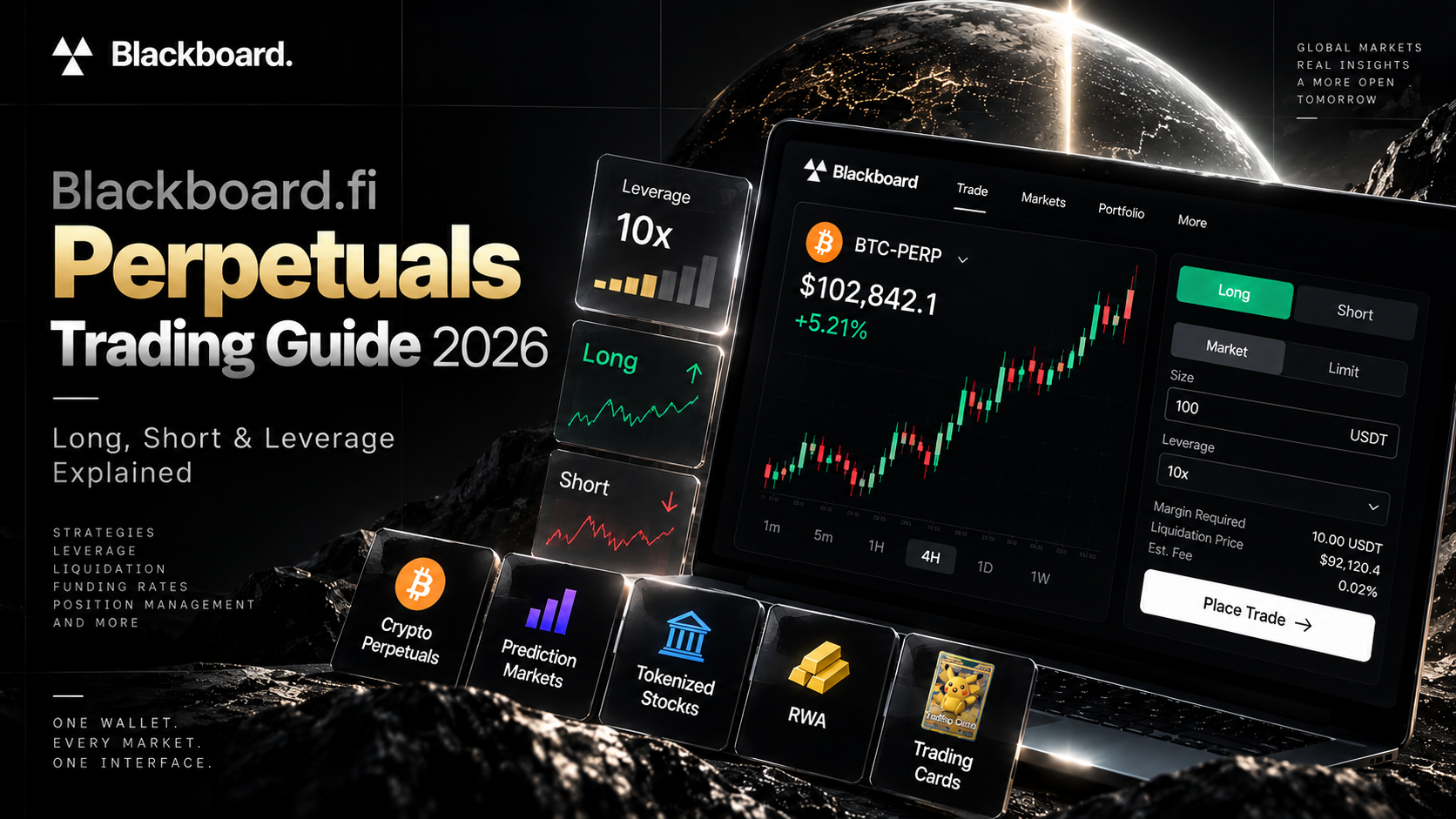
Perpetuals are one of the core trading markets available through Blackboard.fi.
Unlike spot trading, where you buy and hold an asset directly, perpetual contracts allow traders to take a position on whether an asset's price will rise or fall.
That means traders can go Long when they expect prices to rise or Short when they expect prices to fall.
Blackboard brings this trading experience into its broader multi-market onchain terminal.
This guide explains how Blackboard.fi perpetuals work and what you should understand before opening your first leveraged position.
What Are Blackboard.fi Perpetuals?
Perpetual contracts, often called Perps, are derivatives that track the price of an underlying market without having a traditional expiration date.
Instead of purchasing Bitcoin directly, for example, a trader can open a BTC perpetual position based on the expected direction of Bitcoin's price.
This makes Perps useful for both bullish and bearish trading strategies.
However, perpetuals can also involve leverage and liquidation, making risk management especially important.
How Do Perpetuals Work on Blackboard.fi?
Blackboard.fi is designed as a multi-market onchain trading terminal rather than a traditional centralized exchange.
Perpetuals are one of the market categories available through this broader interface.
The basic trading process can be summarized as follows.
The exact assets, leverage limits and trading conditions can differ between markets, so the information displayed on the current Blackboard trading screen should always be checked before placing an order.
Trade Perpetuals on Blackboard.fi
Long vs Short on Blackboard
Long and Short are the two basic directions used in perpetual trading.
| Position | Market Expectation | Profits When |
|---|---|---|
| Long | Price will rise | Market moves higher |
| Short | Price will fall | Market moves lower |
Suppose Bitcoin is trading at $100,000.
If you believe Bitcoin will rise, you could open a Long position.
If you expect Bitcoin to fall, you could instead open a Short position.
The position moves toward a loss when the market moves against your chosen direction.
What Is Leverage?
Leverage allows a trader to control a position larger than the margin committed to the trade.
Consider a simplified example using 100 USDT.
| Margin | Leverage | Position Exposure |
|---|---|---|
| 100 USDT | 1x | 100 USDT |
| 100 USDT | 2x | 200 USDT |
| 100 USDT | 5x | 500 USDT |
| 100 USDT | 10x | 1,000 USDT |
At 10x leverage, 100 USDT of margin creates approximately 1,000 USDT of market exposure.
This does not mean leverage simply multiplies profits.
Losses are amplified as well.
Higher leverage can also reduce the amount of adverse price movement a position can withstand before liquidation becomes a concern.
What Is Liquidation?
Liquidation occurs when a leveraged position can no longer satisfy the required margin conditions and is forcibly closed.
This is one of the most important risks in perpetual trading.
For this reason, the liquidation price should be reviewed before opening a leveraged position rather than only after the market begins moving against it.
Position Size Matters
Leverage is not the only factor determining risk.
Position size is equally important.
A trader with 1,000 USDT available does not need to commit the entire balance to a single position.
Using a smaller portion of the available balance can leave more flexibility if market conditions change.
Before placing an order, consider both the amount of margin committed and the total market exposure created by leverage.
Market Orders vs Limit Orders
Perpetual trading interfaces commonly provide multiple ways to enter a position.
Two fundamental order types are Market and Limit.
| Order Type | How It Works |
|---|---|
| Market | Attempts to execute using currently available prices |
| Limit | Attempts to execute at a specified price or better |
A Market order is useful when execution speed is the priority.
A Limit order gives the trader more control over the requested entry price but may remain unfilled if the market never reaches that level.
Available order types should be checked directly on the current Blackboard trading interface.
What Should You Check Before Opening a Position?
Before confirming a perpetual trade, review the important order information.
Checking these details before every trade can prevent simple mistakes such as selecting the wrong direction or entering an unintended position size.
Understanding PnL
PnL stands for Profit and Loss.
It shows how the current position is performing as the market moves.
For example:
+25 USDT indicates the position is currently approximately 25 USDT in profit.
-25 USDT indicates the position is currently approximately 25 USDT in loss.
Until the position is closed, this value can continue changing with the market.
The position screen should therefore be monitored after a trade is opened.
What Is Funding Rate?
Perpetual contracts do not have the same fixed expiration date as traditional futures.
Many perpetual markets therefore use a mechanism known as a Funding Rate to help keep perpetual prices aligned with their underlying market.
Depending on market conditions, funding payments can flow between Long and Short positions.
This means a trader holding a position for an extended period should consider more than price direction alone.
Funding can also affect the overall economics of maintaining the trade.
Take Profit and Stop Loss
Where supported, Take Profit and Stop Loss orders can help manage an open position.
Take Profit sets a condition designed to close the position after the market reaches a desired profit level.
Stop Loss sets a condition designed to exit when the market moves against the position beyond a chosen level.
These tools do not eliminate trading risk, but they can provide a more structured approach to position management.
Closing a Blackboard Perpetual Position
When you no longer want to maintain a trade, the position needs to be closed.
Check the active position, choose the available Close option and review the size and execution details before confirming.
Depending on the market, partial position closing may also be available.
Remember that an unrealized profit is still exposed to market movement until the position is actually closed.
Blackboard.fi and Aster Perpetuals
Blackboard has publicly identified Aster as one of its early Perps integration partners.
This illustrates an important part of the Blackboard model.
Rather than rebuilding every perpetual market and its liquidity from scratch, Blackboard's broader strategy is to connect existing onchain market infrastructure through a unified trading interface.
For traders, the focus becomes the Blackboard interface while the underlying market infrastructure can come from connected protocols.
Blackboard.fi and Hyperliquid Markets
Hyperliquid is also relevant to understanding Blackboard's broader market strategy.
Blackboard has highlighted existing perpetual infrastructure such as Hyperliquid when explaining why it prefers connecting strong protocols instead of rebuilding every market.
The broader Hyperliquid ecosystem also demonstrates how onchain perpetual markets can expand beyond standard BTC and ETH trading.
Depending on current integrations and market availability, traders may encounter a wider range of onchain perpetual products.
Always use the current Blackboard interface to determine which markets are actually available.
Why Trade Perpetuals Through Blackboard?
The main Blackboard value proposition is broader than one perpetual market.
An active onchain trader may otherwise use separate interfaces for crypto Perps, prediction markets, tokenized assets and other products.
Blackboard aims to bring those experiences together.
| Traditional Approach | Blackboard Approach |
|---|---|
| Separate Perp platform | Perps inside one terminal |
| Separate prediction platform | Prediction Markets in the same ecosystem |
| Multiple market interfaces | Unified market discovery |
| Fragmented workflow | Multi-market interface |
This is the idea behind:
One wallet. Every market. One interface.
Blackboard Perpetuals for Beginners
If you are new to perpetual trading, there is no need to use every advanced feature immediately.
A simpler approach is to first understand how a small position behaves.
Understanding the complete lifecycle of a position is more important than immediately maximizing leverage.
Blackboard.fi Perpetuals FAQ
Does Blackboard.fi support perpetual trading?
Crypto Perpetuals are one of the major market categories presented by Blackboard. Actual supported markets should be checked on the current platform.
Can I Long Bitcoin on Blackboard?
Where a supported BTC perpetual market is available, Long is the direction used when expecting Bitcoin's price to rise.
Can I Short crypto on Blackboard?
Short positions are used in supported perpetual markets when a trader expects the underlying market to decline.
Does Blackboard offer leverage?
Perpetual markets may provide leverage. Available leverage levels can differ depending on the underlying market and current trading conditions.
Can a Blackboard perpetual position be liquidated?
Leveraged perpetual positions can face liquidation if margin requirements are no longer maintained.
What is PnL?
PnL means Profit and Loss and represents the current performance of a position.
What is a funding rate?
Funding is a mechanism commonly used by perpetual markets to help keep perpetual prices aligned with the underlying market. Payments can vary based on market conditions.
Is high leverage better?
Higher leverage creates greater exposure with the same margin, but it also increases risk and can reduce the amount of adverse price movement a position can tolerate.
Blackboard.fi Perpetuals: Final Summary
Blackboard.fi brings perpetual trading into its wider multi-market onchain terminal.
The essential concepts are straightforward:
The important part is not simply predicting whether the market will rise or fall.
Position size, leverage, liquidation and ongoing position management all affect the final result.
Blackboard's broader advantage is its attempt to place perpetuals alongside other onchain markets within a common trading experience.
Explore Blackboard.fi Perpetuals
This page contains a referral link. CryptoCard.Life may receive a referral benefit if you sign up or use Blackboard through this link.
Perpetual and leveraged trading involves significant risk, including the possible loss of principal and liquidation. Markets, leverage, fees, funding and trading features can change. Always check the current information displayed on Blackboard.fi before trading.