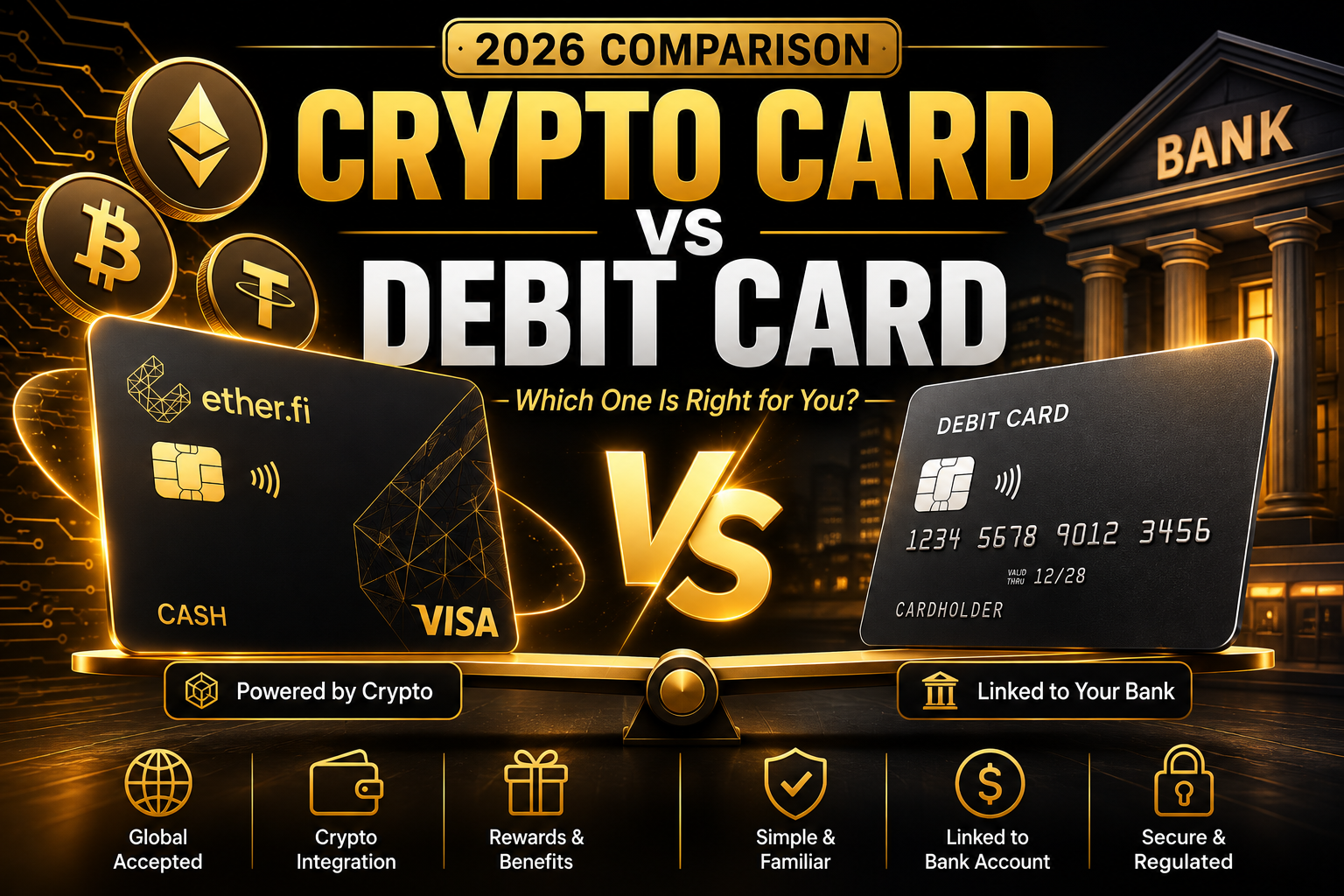
A crypto card can look almost identical to the debit card already sitting in your wallet.
You can use both for online shopping, restaurants, subscriptions and everyday purchases.
But behind the payment, they can work very differently.
A traditional debit card normally draws money directly from your bank account.
A crypto card can connect spending to stablecoins, cryptocurrency balances or even crypto-backed credit.
So which one makes more sense in 2026?
The answer depends on what assets you hold, how you spend money and whether you actually need crypto connected to your everyday payments.
💡 Quick Answer
A debit card usually spends money directly from a bank account.
A crypto card connects card payments with digital assets or crypto-based financial infrastructure.
The better choice depends on funding, fees, rewards, availability and how comfortable you are managing crypto.
What Is a Traditional Debit Card?
A debit card is connected to money you already hold, usually in a checking account.
When you make a purchase, the amount is generally deducted from your available balance.
For most people, this structure is easy to understand.
If you have $1,000 in your account and spend $100, your available balance falls accordingly.
What Is a Crypto Card?
“Crypto card” is a broader term.
It can describe several different products.
This is why comparing crypto cards based only on the word “crypto” can be misleading.
Two products may both be marketed as crypto cards while operating very differently behind the scenes.
Crypto Card vs Debit Card at a Glance
| Feature | Crypto Card | Traditional Debit Card |
|---|---|---|
| Funding | Crypto, stablecoins or credit structure | Bank balance |
| Digital assets | Often integrated | Usually not |
| Spending network | Often Visa or Mastercard | Visa or Mastercard |
| KYC | Usually required | Required by bank |
| Crypto conversion | May occur | Not applicable |
| Rewards | Product dependent | Bank dependent |
| Market exposure | Possible | No direct crypto exposure |
| Complexity | Medium to high | Low |
| Availability | Country/state dependent | Bank dependent |
The biggest difference isn't what happens at the checkout terminal.
It's where the money behind the transaction comes from.
How Does a Crypto Debit Card Work?
A crypto debit card generally connects spending with assets held in a crypto account or card balance.
Depending on the provider, those assets might include:
When you make a purchase, the provider may use a funded balance or convert eligible crypto into the currency needed to settle the card transaction.
The merchant generally doesn't need to accept cryptocurrency directly.
From the merchant's perspective, it can still look like an ordinary card payment.
How Is a Crypto-Backed Credit Card Different?
Not every crypto card spends down your crypto balance.
A crypto-backed credit card can use eligible digital assets as part of the backing for spending capacity.
That creates an important distinction.
Spending crypto and borrowing against crypto are not the same thing.
| Crypto Debit Model | Crypto-Backed Credit Model |
|---|---|
| Uses funded assets | Uses credit capacity |
| Assets may be converted | Eligible assets may provide backing |
| No credit balance in typical model | Repayment can be required |
| No collateralized borrowing | Collateral rules may apply |
| Simpler structure | More financial variables |
For crypto holders, this distinction can significantly affect how a card fits into an overall financial strategy.
Why Use a Crypto Card Instead of a Debit Card?
For someone who already operates primarily through a bank account, a normal debit card may be perfectly adequate.
Crypto cards become more interesting when digital assets are already part of your finances.
Potential reasons include:
The benefit isn't simply that the card has “crypto” printed on it.
The real question is whether the infrastructure behind the card solves a problem you actually have.
Why Use a Debit Card Instead?
Traditional debit cards have one major advantage:
simplicity.
You don't need to understand wallets, collateral, token conversions or blockchain transactions.
Your spending comes from cash already held at your financial institution.
A debit card may make more sense if you:
- receive most of your income in fiat,
- don't regularly hold cryptocurrency,
- want simple budgeting,
- don't want exposure to crypto volatility,
- or don't need on-chain financial tools.
Crypto integration adds functionality, but it can also add complexity.
Stablecoins Change the Comparison
Stablecoins make the crypto card vs debit card comparison more interesting.
Assets such as USDT and USDC are designed to track the value of fiat currencies such as the U.S. dollar.
For users who already keep part of their money in stablecoins, moving value back into a traditional bank account every time they want to spend can create extra steps.
A compatible crypto card can potentially reduce some of that friction.
However, stablecoins still aren't identical to cash held in a traditional bank account.
Users should understand the issuer, custody arrangement, conversion process and applicable risks.
Can You Pay Directly With USDT?
This depends on what “directly” means.
A card may support USDT as a funding asset without the merchant actually receiving USDT.
For example, the process may look like:
USDT → card infrastructure → merchant payment
rather than:
USDT → merchant wallet
That distinction matters.
A crypto card can make digital assets usable through conventional payment infrastructure without requiring every merchant to become a crypto merchant.
Crypto Card Fees vs Debit Card Fees
Costs can also work differently.
| Cost | Crypto Card | Debit Card |
|---|---|---|
| Card issuance | Possible | Often low/free |
| Crypto conversion | Possible | Not applicable |
| FX | Possible | Possible |
| ATM | Possible | Possible |
| Membership | Product dependent | Account dependent |
| Blockchain costs | Sometimes relevant | Not applicable |
| Replacement | Possible | Possible |
A crypto card advertising high rewards isn't necessarily cheaper.
You should calculate the total cost of using the card.
Which Card Has Better Rewards?
There isn't a universal answer.
Traditional banks may offer cashback, merchant discounts or other account benefits.
Crypto cards can offer cashback or crypto-related rewards.
But headline reward percentages should be treated carefully.
For example:
| Card | Headline Reward | Costs | Actual Value |
|---|---|---|---|
| Example A | 5% | Higher | Depends |
| Example B | 3% | Lower | Depends |
These are illustrative numbers, not actual card offers.
The point is simple:
5% cashback isn't automatically better than 3% cashback.
Eligibility, monthly caps, excluded purchases and fees all affect real value.
Does a Crypto Card Require KYC?
Most legitimate card programs connected to mainstream payment networks require identity verification.
Typical verification can include:
A crypto card shouldn't automatically be associated with anonymous spending.
The card component operates within financial and payment-network requirements that can differ from simply holding crypto in a self-custody wallet.
What About No-KYC Crypto Cards?
Searches for “no KYC crypto card” are common.
But users should distinguish between:
- a crypto wallet,
- an anonymous blockchain transaction,
- a virtual payment product,
- and a regulated Visa or Mastercard card.
They aren't the same thing.
A product claiming to offer completely anonymous card spending deserves additional scrutiny regarding issuer structure, geographic availability, funding, limits and compliance.
Are Crypto Cards Safe?
Safety depends heavily on the provider and how the product is structured.
Traditional debit cards and crypto cards can involve different risks.
| Risk | Crypto Card | Debit Card |
|---|---|---|
| Account compromise | Yes | Yes |
| Card fraud | Yes | Yes |
| Crypto volatility | Possible | No |
| Smart-contract risk | Product dependent | No |
| Stablecoin risk | Product dependent | No |
| Bank-related risk | Less direct | Yes |
| Collateral risk | Credit products | No |
Crypto users should think beyond card-number security.
The assets and infrastructure connected to the card matter too.
What Happens If Crypto Prices Fall?
For a simple stablecoin-funded card, the effect can be different from a card connected to volatile assets.
For a crypto-backed credit product, falling collateral values can be particularly important.
This is a risk that doesn't exist in the same form with an ordinary debit card.
Ether.fi Cash: An Example of a Different Card Model
Ether.fi Cash is useful for understanding why the term “crypto card” covers more than crypto debit cards.
Cash is designed around a crypto-backed credit structure and uses the Visa payment network.
Instead of treating the product as simply a bank debit card funded with crypto, users should understand its collateral and repayment mechanics.
For someone already holding on-chain assets, that can create a very different spending model from a traditional debit card.
Crypto Card vs Debit Card for Travel
Travel is another area where the comparison becomes interesting.
Both card types may work internationally when supported by their respective payment networks.
But travelers should check:
Don't assume a crypto card is automatically a better international card simply because cryptocurrency itself is global.
The card still operates through a payment provider with its own rules and fees.
Crypto Card vs Debit Card for Online Shopping
For ordinary online purchases, the checkout experience may be nearly identical.
You enter:
- card number,
- expiration date,
- security code,
- and billing information.
The important differences happen behind the transaction.
A debit card pulls from a conventional financial account.
A crypto card may interact with stablecoins, digital assets, a funded balance or a crypto-backed credit account.
Crypto Card vs Debit Card for Crypto Holders
If most of your assets are already held on-chain, a crypto card can become more useful.
Consider someone who:
- holds ETH long term,
- receives stablecoins,
- uses DeFi,
- maintains a self-custody wallet,
- and regularly moves money between crypto and traditional accounts.
For that person, crypto-connected spending can potentially remove some friction.
For someone who simply buys $50 of Bitcoin occasionally, the additional complexity may provide much less value.
Which One Is Better?
It depends on the user.
| User | Potential Better Fit |
|---|---|
| Mostly uses a bank account | Debit card |
| New to crypto | Debit card |
| Holds stablecoins | Crypto card worth comparing |
| Active on-chain user | Crypto card |
| Wants simple budgeting | Debit card |
| Wants crypto-backed spending | Crypto-backed card |
| Doesn't understand collateral | Avoid complex credit products |
The goal isn't to replace a debit card just because crypto cards exist.
The goal is to choose the payment structure that fits how you actually manage money.
Can You Have Both?
Absolutely.
For many users, this may actually be the most practical approach.
A traditional debit card can remain connected to everyday banking.
A crypto card can serve specific purposes related to digital assets.
These products don't necessarily need to replace one another.
They can serve different roles.
Frequently Asked Questions
Is a crypto card the same as a debit card?
Not necessarily. Some crypto cards use a debit or prepaid structure, while others use crypto-backed credit. “Crypto card” describes a broader category.
Is a crypto debit card linked to a bank account?
Usually not in the same way as a traditional bank debit card. It can instead be connected to a crypto account, funded balance or digital assets depending on the provider.
Can I use USDT with a crypto card?
Some crypto cards support USDT or other stablecoins. The exact spending and conversion process depends on the card.
Does a merchant receive cryptocurrency when I use a crypto card?
Usually the merchant receives payment through the traditional card network rather than receiving cryptocurrency directly.
Are crypto cards better than debit cards?
Neither is universally better. Debit cards offer simplicity, while crypto cards can provide useful integration for people who already hold and use digital assets.
Do crypto cards require KYC?
Mainstream crypto card programs generally require identity verification and eligibility checks.
Can a crypto card replace my bank account?
A card alone shouldn't be assumed to replace all banking functions. Crypto cards and traditional financial accounts have different features, protections and risks.
Is Ether.fi Cash a crypto debit card?
Ether.fi Cash is structured as a crypto-backed credit product rather than a conventional crypto debit card.
Does Ether.fi Cash use Visa?
Yes. Ether.fi Cash operates through the Visa payment network.
Final Takeaway
A traditional debit card and a crypto card can look almost identical at checkout.
But financially, they may be completely different products.
A debit card generally gives you access to money already sitting in a bank account.
A crypto card can connect spending with stablecoins, crypto balances, on-chain assets or crypto-backed credit.
For people who live primarily in traditional finance, the simplicity of a debit card can still be hard to beat.
For people who already hold and use digital assets, a crypto card can potentially make the connection between crypto and everyday spending much more practical.
And for users specifically interested in maintaining crypto exposure while accessing card-based spending, crypto-backed products such as Ether.fi Cash offer another model to consider.
Before choosing any card, compare the structure — not just the rewards.