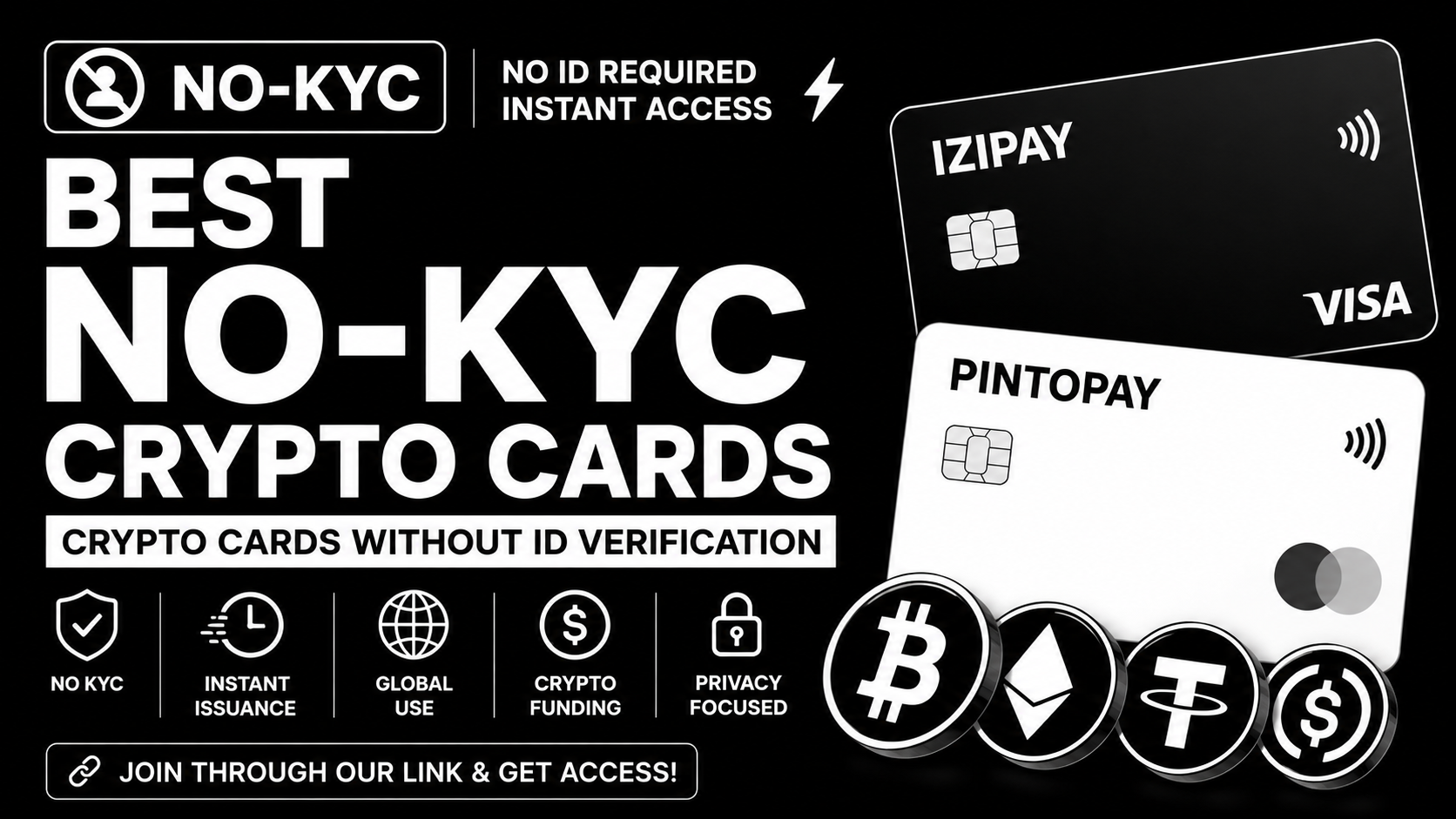
Crypto cards have made it much easier to turn digital assets into something you can actually spend.
But there is one problem.
Many crypto cards require Know Your Customer (KYC) verification before you can even get started.
That can mean uploading a passport or government ID, taking a selfie, entering your address, and waiting for verification.
So what if you simply want a virtual crypto card without going through the full traditional KYC process?
That is where No-KYC crypto cards come in.
In this guide, we’ll look at IZIPAY and PintoPay, explain what “No-KYC” really means, and compare them with a more mainstream option such as Ether.fi Cash.
What Is a No-KYC Crypto Card?
A No-KYC crypto card is generally a card that allows users to access at least some features without completing the full identity-verification process normally associated with financial services.
The important word here is “full.”
No-KYC does not necessarily mean completely anonymous.
A provider may still require an email address, Telegram account or other basic information. Additional verification may also be triggered by transaction limits, compliance requirements or suspicious activity.
No-KYC vs Regular Crypto Cards
FeatureNo-KYC Crypto CardRegular KYC Crypto CardGovernment IDMay not be required initiallyUsually requiredSelfie verificationMay not be requiredCommonAddress verificationOften reducedMay be requiredSetupUsually fasterMore stepsVirtual cardCommonCommonPhysical cardLess commonMore commonSpending limitsCan be more restrictiveOften higherBest forQuick virtual card accessEveryday long-term useSo the real advantage isn't necessarily anonymity.
It's convenience.
1. IZIPAY: A No-KYC Virtual Crypto Card Option
If avoiding traditional identity verification is your main priority, IZIPAY is one of the first options worth looking at.
According to IZIPAY's published information, users can obtain its basic virtual crypto card without submitting the standard combination of government ID, selfie and proof of address. Its service is designed around funding virtual cards with cryptocurrency.
That makes it particularly interesting for users who already hold assets such as USDT and want a relatively straightforward path to card spending.
IZIPAY at a glance
FeatureIZIPAYCard typeVirtualBasic KYCNot required for basic card according to providerCrypto fundingYesUSDTSupportedApple Pay / Google PayProvider advertises supportPhysical cardNot the primary use caseBest forUsers prioritizing simple virtual-card issuanceOne thing to remember: No-KYC status can be subject to limits and compliance checks.
A provider can still request additional verification depending on how an account is used.
Who should consider IZIPAY?
IZIPAY makes the most sense if your priority is:
“I want a crypto-funded virtual card without completing a lengthy traditional KYC process.”
Get an IZIPAY card with our referral link
2. PintoPay: A Telegram-Based Crypto Card Alternative
PintoPay takes a different approach.
Instead of a traditional banking-style interface, the service can be accessed through Telegram, which may appeal to crypto users who want a simpler onboarding experience.
However, there's an important distinction.
We would not describe PintoPay as a guaranteed No-KYC card for every user.
Its current verification requirements should be checked during registration because requirements can vary or change.
PintoPay at a glance
FeaturePintoPayAccessTelegramVirtual cardAvailable through the serviceKYCCheck current requirementsSetupDesigned to be simpleBest forTelegram-native crypto usersIf PintoPay interests you, check the current card issuance and verification requirements before depositing significant funds.
Open PintoPay via our referral link
Which No-KYC Crypto Card Should You Choose?
Here's the simple version.
If you want...ConsiderMinimal traditional verificationIZIPAYA virtual crypto cardIZIPAYTelegram-based accessPintoPayA mainstream everyday crypto cardEther.fi CashPhysical card + everyday spendingEther.fi CashFor someone specifically searching for a No-KYC crypto card, IZIPAY is the more straightforward starting point of these two because its basic card verification policy is more clearly described.
But that doesn't necessarily make it the best overall crypto card.
That depends on what you actually want to do with the card.
No-KYC Isn't Always Better
This is where crypto card comparisons often become misleading.
A card can be incredibly easy to open but expensive or inconvenient to use.
Before choosing any No-KYC card, compare these five things:
1. Card issuance fee
How much does it cost to create the card?
2. Crypto funding fee
What happens when you move USDT or another cryptocurrency onto the card?
3. Spending and FX fees
How much do you actually lose when making purchases in another currency?
4. Spending limits
No-KYC products may have tighter limits.
5. Long-term reliability
A card you plan to use every week should be evaluated differently from a temporary virtual card.
This leads to an important distinction.
No-KYC Card vs Everyday Crypto Card
If your only goal is getting a virtual card with minimal verification, a product such as IZIPAY can make sense.
But if you want to use crypto for regular everyday spending, we would look at a different category.
That's where Ether.fi Cash becomes interesting.
Ether.fi Cash is not a No-KYC card.
Users have to complete identity verification before using the card.
In exchange, Ether.fi Cash is designed as a more complete crypto spending product, with virtual and physical card options and crypto-backed spending features.
IZIPAY vs Ether.fi Cash
IZIPAYEther.fi CashNo-KYCBasic card can qualify❌Virtual card✅✅Physical cardLimited focus✅Everyday spendingPossibleStrong focusCrypto integration✅StrongCashbackNot the main appealAvailable depending on program/tierBest useSimple virtual cardMain crypto spending cardThis is why we wouldn't choose a crypto card based on KYC alone.
What About an “Anonymous Crypto Card”?
You'll often see phrases such as:
anonymous crypto card
crypto debit card without verification
crypto card without ID
untraceable crypto card
These terms shouldn't automatically be treated as synonyms.
A card that doesn't require government ID during initial registration is not necessarily anonymous or untraceable.
Blockchain transactions can be publicly visible, card networks process payment information, and card providers can still be subject to financial and anti-money-laundering requirements.
So if privacy is important to you, look at the provider's actual verification and privacy policies rather than assuming that No-KYC = anonymous.
Our Pick: Which Crypto Card Makes the Most Sense?
For minimal verification, start by looking at IZIPAY.
For Telegram-based access, PintoPay is another option worth checking, although its current verification requirements should be confirmed before applying.
But if the question is:
“Which crypto card would I actually want as my main card?”
Our choice is Ether.fi Cash.
The KYC process adds an extra step, but for users who want a card for regular crypto spending rather than simply avoiding identity verification, its broader card functionality makes it a stronger overall option.
Apply for Ether.fi Cash through CryptoCard.Life
Final Verdict
No-KYC crypto cards solve a very specific problem.
They make it possible to access certain crypto card services without immediately going through the full traditional identity-verification process.
For that purpose, IZIPAY is the option we'd look at first, while PintoPay is worth checking for users who prefer a Telegram-based experience.
But don't make KYC the only deciding factor.
If you want a card for occasional virtual payments, prioritize easy issuance.
If you want a card that becomes part of your everyday spending setup, prioritize fees, limits, reliability, physical-card availability and crypto integration.
That's why our overall approach is simple:
No-KYC virtual card → IZIPAY
Telegram-based alternative → PintoPay
Main everyday crypto card → Ether.fi Cash
Crypto card availability, fees, KYC requirements and limits can change by country and over time. Always check the provider's latest terms before applying or depositing funds. Some links on CryptoCard.Life are referral links, which means we may receive a reward if you sign up through them.