Holding crypto is easy.
Spending it in everyday life is the part that used to be complicated.
You could own Bitcoin, Ethereum or Tether, but paying for coffee, shopping online or booking a hotel often meant selling crypto, moving the money to a bank and then paying with a traditional card.
Crypto cards are designed to shorten that process.
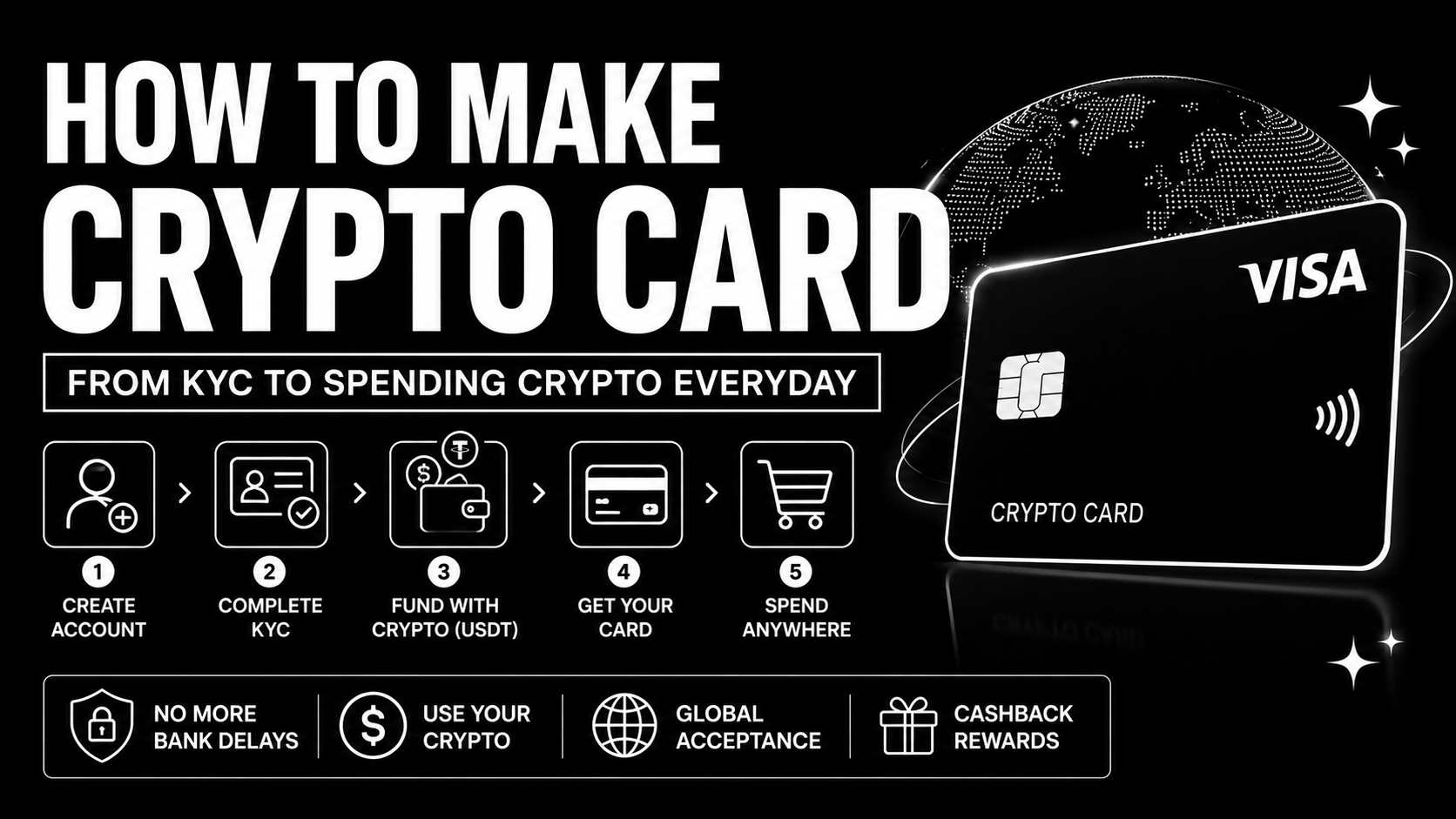
Today, you can create an account, verify your identity, fund it with crypto and receive a virtual or physical payment card.
So how does it actually work?
Here is the process from start to finish.
Step 1. Choose the Right Crypto Card
This is more important than it looks.
Not every crypto card works the same way.
Some cards are essentially prepaid virtual cards. Others connect to an exchange account, while newer products can integrate directly with on-chain assets.
Before applying, compare:
- Supported countries
- KYC requirements
- Supported cryptocurrencies
- Virtual and physical cards
- Card network
- Funding fees
- Foreign exchange fees
- Spending limits
- Cashback
- Apple Pay / Google Pay support
For someone looking for a main everyday crypto card, our first choice is Ether.fi Cash.
Why?
Because it goes beyond simply converting crypto into a prepaid card balance.
Ether.fi describes Cash as a non-custodial crypto-backed Visa credit card designed for everyday spending, with cashback and crypto funding options.
Get Ether.fi Cash through CryptoCard.Life
Step 2. Create Your Account
The next step is straightforward.
With Ether.fi, you start by creating an account using an email address.
After verifying the email, you can access the platform and continue setting up the features you want to use.
Think of this as creating the account that will connect your crypto assets and card.
Step 3. Complete KYC Verification
If you're applying for a mainstream crypto card, expect to complete KYC.
KYC means Know Your Customer.
It is the identity-verification process financial platforms use to confirm who is opening the account.
For Ether.fi Cash, KYC is required before a Cash card can be issued.
What will you normally need?
VerificationEther.fi CashPhone verification✓Government ID✓Passport accepted✓National ID accepted✓Driver's license accepted✓Selfie / liveness check✓Residential information✓Proof of addressSometimesEther.fi says verification normally involves a phone number, valid government-issued identification, a selfie/liveness check and personal information. Additional documentation can be requested depending on jurisdiction.
Tip: Don't rush your KYC
Use clear photographs.
Make sure the ID hasn't expired and enter your information exactly as it appears on your documents.
Small inconsistencies can delay verification.
Step 4. Get Your Virtual or Physical Crypto Card
Once your account is approved, you can move on to the actual card.
A virtual crypto card is generally the easiest place to start because it can be used for online payments without waiting for a physical card to arrive.
A physical card makes more sense if you want the familiar experience of paying in stores or carrying the card while traveling.
Ether.fi currently lists physical-card availability across many supported jurisdictions, including South Korea, Japan, Singapore, the United Kingdom, Canada and numerous U.S. states. Availability can change over time.
For its physical card, the process is essentially:
Cash → Add Card → Physical Cards → set preferences → enter shipping address → order
KYC must be completed first.
Step 5. Fund Your Card With Crypto
Now we get to the interesting part.
Instead of transferring money from a traditional bank every time you want to spend, crypto-card platforms allow you to fund an account using digital assets.
For users who already hold stablecoins, this can make crypto much more practical.
Ether.fi's account documentation currently includes support for stablecoin deposits on networks including USDT on Tron and USDC on Solana.
That means a typical user journey can look like this:
Exchange or wallet
↓
Send crypto to your supported account
↓
Crypto becomes part of your card ecosystem
↓
Use your card for everyday purchases
But there's an important distinction.
Can You Spend USDT Directly With Ether.fi Cash?
This needs a little explanation.
Many people searching for a USDT card or Tether card assume the merchant literally receives USDT.
That's usually not what happens.
The merchant receives a normal card payment through the card network.
Behind the scenes, the crypto-card platform handles the crypto side.
Ether.fi currently supports USDT deposits on Tron, but its Direct Pay Mode documentation states that USDC and LiquidUSD are currently the eligible direct-spending assets, with USDC used first.
So don't think of a crypto card as:
“The supermarket accepts Tether.”
Think of it as:
“My crypto account connects to a normal card payment system.”
That distinction matters.
What Happens When You Pay?
Imagine buying a $20 lunch.
You tap your crypto card just like a normal payment card.
From the merchant's perspective, it's a card transaction.
On the crypto side, the platform handles the corresponding settlement according to the card's payment mode.
Ether.fi says its Cash card can be used anywhere Visa is accepted, subject to its terms and restrictions.
So your experience becomes much closer to:
Crypto → Card → Everyday purchase
rather than:
Crypto → Exchange → Sell → Bank → Traditional card → Purchase
That's the real appeal of a crypto card.
Direct Pay vs Crypto-Backed Credit
Ether.fi also has another interesting distinction.
You don't necessarily have to use the card in only one way.
Direct Pay
Eligible crypto assets are deducted when you spend.
This is the simpler option for people who essentially want:
crypto balance → purchase
Borrow Mode
Instead of immediately selling eligible crypto holdings, assets can be used as collateral while the user borrows for purchases.
Interest applies to borrowed balances and rates are variable, so this mode needs to be understood before using it.
ModeBest suited forDirect PaySimple everyday purchasesBorrow ModeSpending without immediately selling collateralVirtual CardOnline purchasesPhysical CardStores and travelFor a beginner, Direct Pay is easier to understand.
What About Cashback?
This is another reason we currently rank Ether.fi highly for everyday crypto spending.
Qualifying Cash card transactions can earn cashback, which Ether.fi says is credited as USDC.
Current cashback rates vary according to membership level and monthly spending, with published rates ranging between 0.5% and 3% per transaction depending on the applicable conditions.
Not every transaction qualifies—ATM withdrawals, P2P payments and certain financial transactions, for example, are excluded.
So cashback should be viewed as an extra benefit rather than the only reason to choose the card.
Is a Crypto Card Worth It?
It depends on what you actually do with crypto.
If you simply buy Bitcoin and hold it for years, you probably don't need one.
But if you regularly hold stablecoins or receive income in crypto, the equation changes.
A crypto card can reduce the friction between owning crypto and actually using it.
A crypto card makes more sense if you:
✓ Hold stablecoins such as USDT or USDC
✓ Regularly move money between crypto and fiat
✓ Travel internationally
✓ Pay for online services with crypto-derived funds
✓ Want a virtual card
✓ Want to integrate crypto into everyday spending
Why Ether.fi Cash Is Our Top Pick
There isn't one crypto card that's perfect for everyone.
Some people want No-KYC.
Some want a disposable virtual card.
Others want an exchange-linked card.
But if the goal is:
“I want one serious crypto card for everyday spending.”
Ether.fi Cash is our current top pick.
The combination of a Visa card, crypto funding, virtual/physical options, cashback, Direct Pay and crypto-backed credit gives it a broader use case than a basic prepaid crypto card.
And for readers in South Korea specifically, Ether.fi currently lists South Korea as a supported jurisdiction with physical-card availability.
How to Get Started
The entire process can be summarized like this:
1. Create an Ether.fi account
↓
2. Complete KYC
↓
3. Open the Cash section
↓
4. Activate your card
↓
5. Fund your account with supported crypto
↓
6. Select the appropriate spending mode
↓
7. Start using crypto for everyday purchases
Apply for Ether.fi Cash with the CryptoCard.Life referral link
Final Verdict
Making a crypto card in 2026 isn't particularly complicated.
The bigger question is which card ecosystem you want to use after you've completed the application.
For most mainstream cards, expect to create an account, complete KYC, activate a virtual or physical card and fund the account with supported assets.
If you're specifically coming from Tether, look carefully at which networks support USDT deposits and which assets are actually eligible for card spending. Those are not always the same thing.
For CryptoCard.Life, our current overall recommendation for users looking for a full-featured everyday crypto card remains Ether.fi Cash.
It requires KYC, but if your goal is to move beyond simply holding crypto and actually start using digital assets in everyday life, that's exactly the type of card we'd look at first.
Crypto card availability, supported assets, networks, fees, cashback and KYC requirements can change. Check the latest provider terms before applying or transferring funds. CryptoCard.Life may receive a referral reward when you register through some links on this page.