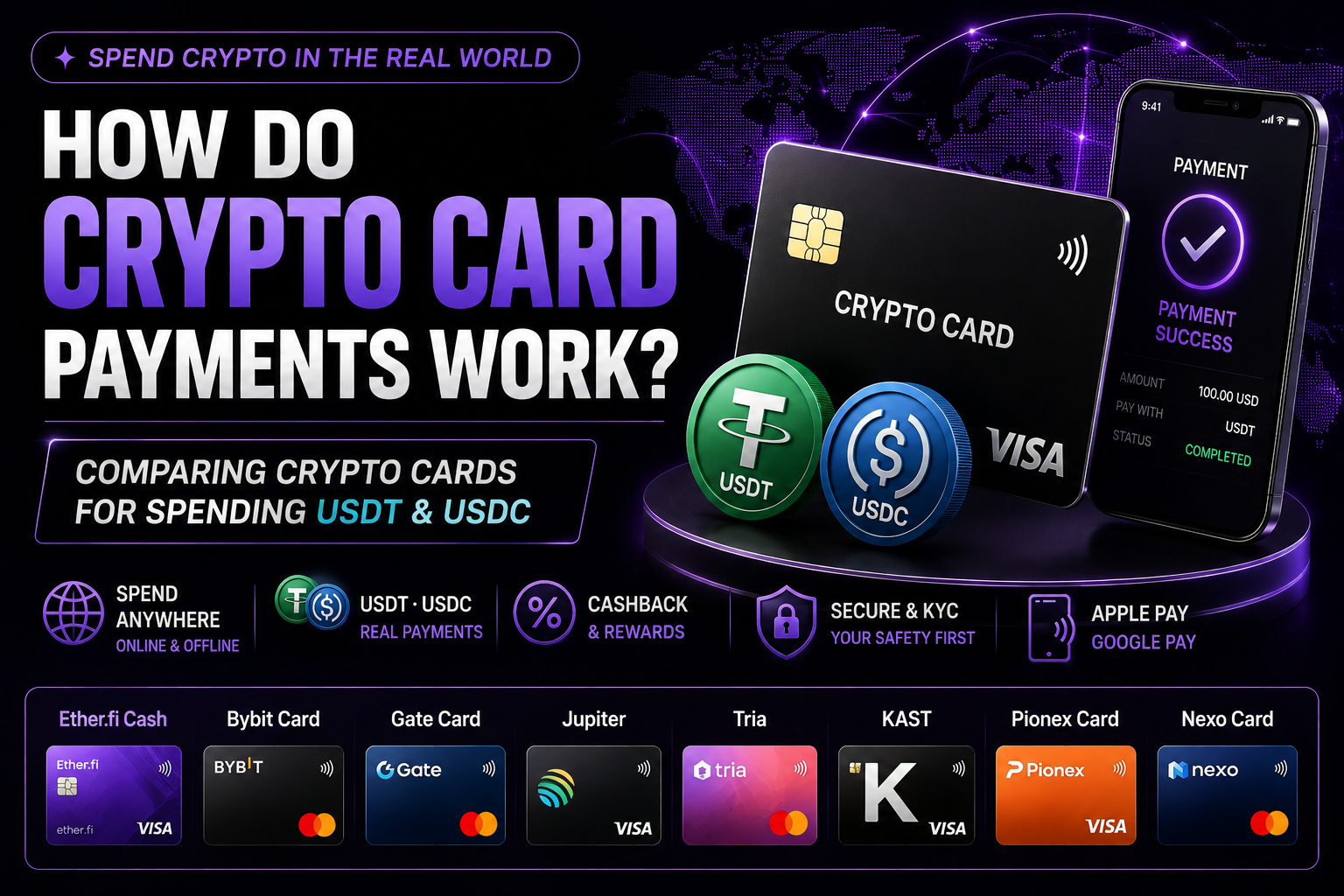
Holding crypto is easy. Spending it in everyday life is a different story.
If you already hold USDT or USDC, you may have wondered:
“Can I spend my stablecoins directly without selling them and withdrawing cash to my bank first?”
With the right crypto card, the answer can be yes.
Crypto cards connect digital assets with traditional card-payment infrastructure, allowing eligible users to use crypto-related balances for purchases at supported merchants.
But crypto cards aren't all built the same way. Supported assets, networks, KYC requirements, country availability, fees, conversion methods, and rewards can differ significantly.
In this guide, we'll explain how crypto card payments work and compare eight options by use case: Ether.fi Cash, Bybit Card, Gate Card, Jupiter, Tria, KAST, Pionex Card, and Nexo Card.
What Is a Crypto Card Payment?
A crypto card payment allows you to use cryptocurrency-related funds through traditional card payment networks.
Suppose you hold USDT and use a crypto card to buy a $10 meal.
That doesn't necessarily mean the restaurant itself receives 10 USDT.
From the user's perspective, crypto or a crypto-funded balance is being used. Behind the scenes, however, the transaction is generally processed through conventional payment infrastructure according to the card provider's and issuer's settlement structure.
A simplified flow looks like this:
Hold Crypto
↓
Connect or Fund Your Crypto Card
↓
Make a Card Payment
↓
The Relevant Crypto or Card Balance Is Debited
This distinction is important because crypto cards effectively act as a bridge between digital assets and conventional payments.
Can You Pay With USDT or USDC Using a Card?
Yes, some crypto cards allow users to fund or use card balances with stablecoins such as USDT and USDC.
Stablecoins are particularly relevant to crypto payments because they are designed to track the value of fiat currencies such as the U.S. dollar.
For someone primarily interested in payments rather than crypto price speculation, this can make budgeting easier than spending a volatile asset such as BTC or ETH.
However, there's another detail to check:
Supporting USDT does not necessarily mean supporting USDT on every blockchain network.
USDT exists across multiple networks, including Ethereum and Tron.
Before sending funds to any crypto-card service, verify the exact asset, network, and deposit address supported by the provider.
Sending crypto over an unsupported network may result in funds being difficult or impossible to recover.
Where Can You Use a Crypto Card?
Where a crypto card can be used depends on its payment network, issuing structure, merchant restrictions, and regional availability.
When a crypto card operates through a major card network, eligible transactions may work similarly to conventional card purchases.
Potential uses can include:
- Online shopping
- Hotels and travel bookings
- Restaurants and cafés
- Software and SaaS subscriptions
- Streaming subscriptions
- International purchases
- Physical retail purchases
- Mobile payments where Apple Pay or Google Pay is supported
However, having a Visa- or Mastercard-linked card does not guarantee approval at every merchant.
Transactions can still be declined because of merchant category restrictions, card BIN rules, geography, issuer policies, or the type of transaction being attempted.
8 Crypto Cards Compared by Use Case
Instead of asking which crypto card is universally "best," it makes more sense to ask:
What do I actually want to do with my crypto card?
| Crypto Card | Main Focus | Best For |
|---|---|---|
| Ether.fi Cash | DeFi + rewards | Everyday spending & cashback |
| Bybit Card | Exchange integration | Existing Bybit users |
| Gate Card | Gate ecosystem | Existing Gate users |
| Jupiter | Solana ecosystem | Solana users |
| Tria | Web3 / multichain | Multichain users |
| KAST | Stablecoin-focused | USDT & USDC users |
| Pionex Card | Exchange integration | Existing Pionex users |
| Nexo Card | Crypto financial services | Existing Nexo users |
Availability and terms can change, so always check the provider's latest eligibility requirements before applying.
1. Ether.fi Cash — For Everyday Spending & Cashback
If your goal isn't simply to own a crypto card but to actually use one regularly, Ether.fi Cash is one of the first options worth comparing.
Ether.fi is widely associated with the Ethereum and DeFi ecosystem, while Cash extends that ecosystem toward real-world payments.
One feature that stands out is its cashback structure.
Depending on the current program, tier, and eligibility conditions, users may be able to earn up to around 3% cashback.
That makes Ether.fi Cash particularly interesting for users who expect to put meaningful monthly spending through their card.
For regular users, the important question isn't just:
“How much does the card cost?”
It is also:
“How much will this card cost—or reward me—after months of actual spending?”
Ether.fi Cash may suit you if:
- You plan to use a crypto card regularly
- Cashback matters to you
- You already use DeFi
- You want to connect crypto with everyday spending
Check Ether.fi Cash:
2. Bybit Card — For Existing Bybit Users
If Bybit is already one of your primary exchanges, Bybit Card may be a natural option to investigate.
Exchange-linked cards can reduce the need to open another completely separate crypto platform and move funds between multiple services.
For existing users, keeping trading, asset management, and card functionality within a familiar ecosystem can be convenient.
There is one important caveat:
Access to Bybit does not automatically mean you're eligible for Bybit Card.
Card availability can vary by country and jurisdiction.
3. Gate Card — For Gate Users
The same principle applies to Gate Card.
If you already hold or trade crypto through Gate, integrating a card within the same ecosystem may simplify asset management.
If you're not already a Gate user, however, compare the card against alternatives based on fees, supported assets, rewards, regional availability, and payment functionality before opening another exchange account solely for the card.
4. Jupiter — For Solana-Focused Users
Not every crypto user is centered around Ethereum or centralized exchanges.
If you spend most of your time in the Solana ecosystem, Jupiter is particularly relevant.
For users holding SOL and interacting with Solana-based assets, choosing payment services closer to the ecosystem they already use may reduce unnecessary transfers and conversions.
This illustrates a broader rule for crypto cards:
The best card may be the one that fits where your assets already live.
5. Tria — For Web3 and Multichain Users
Some users keep their assets across several chains, wallets, and Web3 applications rather than on a single exchange.
For those users, Tria is another option worth comparing.
The important question isn't simply whether the card itself is cheap.
Instead, examine the full path:
Supported Networks → Supported Assets → Conversion → Card Payment → Total Cost
If spending your assets requires several swaps or bridges first, a seemingly inexpensive card may become inconvenient or expensive in practice.
6. KAST — For Stablecoin Users
If your primary goal is spending USDT or USDC, a stablecoin-oriented service such as KAST may be more relevant than a card designed around a specific exchange.
Many crypto-card users aren't necessarily looking to spend Bitcoin.
They simply want to hold dollar-denominated stablecoins and use those balances for everyday or international purchases.
In this case, compare supported stablecoins, deposit networks, payment fees, FX costs, limits, and regional availability.
7. Pionex Card — For Existing Pionex Users
If you're already using Pionex for trading or automated strategies, Pionex Card may fit naturally into your existing setup.
As with Bybit and Gate, the main advantage of an exchange-linked card is convenience for existing customers.
If you're not currently a Pionex user, evaluate the card independently before deciding whether opening another exchange account is worthwhile.
8. Nexo Card — For Crypto Finance + Payments
Nexo Card makes more sense when viewed as part of Nexo's broader crypto-financial ecosystem rather than simply as an isolated payment card.
If you already use Nexo—or plan to use its broader services—integrating payments within the same ecosystem may be useful.
If you're only looking for a straightforward way to spend stablecoins, compare its overall structure against simpler alternatives.
If You Spend $1,000, What Actually Matters?
A common mistake when comparing crypto cards is focusing almost entirely on the card issuance fee.
For regular users, that may be one of the least important costs.
Consider the total cost of spending:
Card Fee + Funding Fees + Network Fees + Payment Fees + FX Costs − Cashback & Rewards
Imagine one card is free to issue but repeatedly charges higher conversion or funding costs.
Another costs $50 upfront but offers lower ongoing costs and useful cashback.
For someone who spends $1,000 every month, the second card could eventually be the cheaper option.
The more you spend, the more recurring fees and rewards matter.
KYC vs. No-KYC Crypto Cards
KYC stands for Know Your Customer, the identity-verification process used by many financial services.
Depending on the provider and jurisdiction, a crypto-card application may require a government-issued ID or passport, selfie verification, address details, or additional documentation.
There are also crypto-card services marketed around reduced or no traditional KYC requirements.
Neither model is automatically the right choice for everyone.
If minimizing identity verification is your priority, you may want to compare No-KYC crypto cards separately.
If you're comfortable completing KYC, you can broaden your comparison to include factors such as cashback, fees, spending limits, supported assets, and payment convenience.
Which Crypto Card Should You Choose?
The easiest approach is to start with your primary use case.
Everyday payments + cashback
→ Ether.fi Cash
Existing Bybit user
→ Bybit Card
Existing Gate user
→ Gate Card
Solana ecosystem
→ Jupiter
Web3 / multichain
→ Tria
USDT & USDC focused
→ KAST
Existing Pionex user
→ Pionex Card
Crypto finance + payments
→ Nexo Card
If you're comfortable with KYC and your main priorities are real-world spending and cashback, Ether.fi Cash is one of the options worth comparing first.
Crypto Card Payments: What You Should Remember
Crypto cards bridge digital assets such as USDT and USDC with conventional card-payment infrastructure.
But the fact that a card lets you "spend crypto" isn't enough to determine whether it's a good card.
Before applying, compare:
Country Eligibility / KYC / Supported Assets / Supported Networks / Funding Fees / Spending Fees / FX Costs / Cashback / Spending Limits / Mobile Wallet Support
Crypto-card conditions can also change as providers, issuers, and regional policies evolve.
For a new card, consider starting with a small deposit and a small test transaction before transferring larger amounts.
Where Can You Compare Crypto Cards?
Comparing crypto cards can be frustrating because each provider presents information differently.
One may highlight cashback while another focuses on issuance fees, and regional eligibility may be buried elsewhere.
CryptoCard.Life brings crypto-card information together in one place, including card comparisons, application guides, KYC information, stablecoin cards, and individual card features.