Crypto is easy to buy and hold. Spending it in everyday life is where things get more complicated.
If you already hold USDT, USDC, ETH, or other crypto assets, you may have wondered:
“Can I spend my crypto directly with a card instead of selling it and withdrawing to a bank account first?”
That is exactly what crypto cards are designed to help with.
A crypto card connects digital assets with traditional card payment infrastructure, allowing eligible users to use crypto-related balances for everyday purchases.
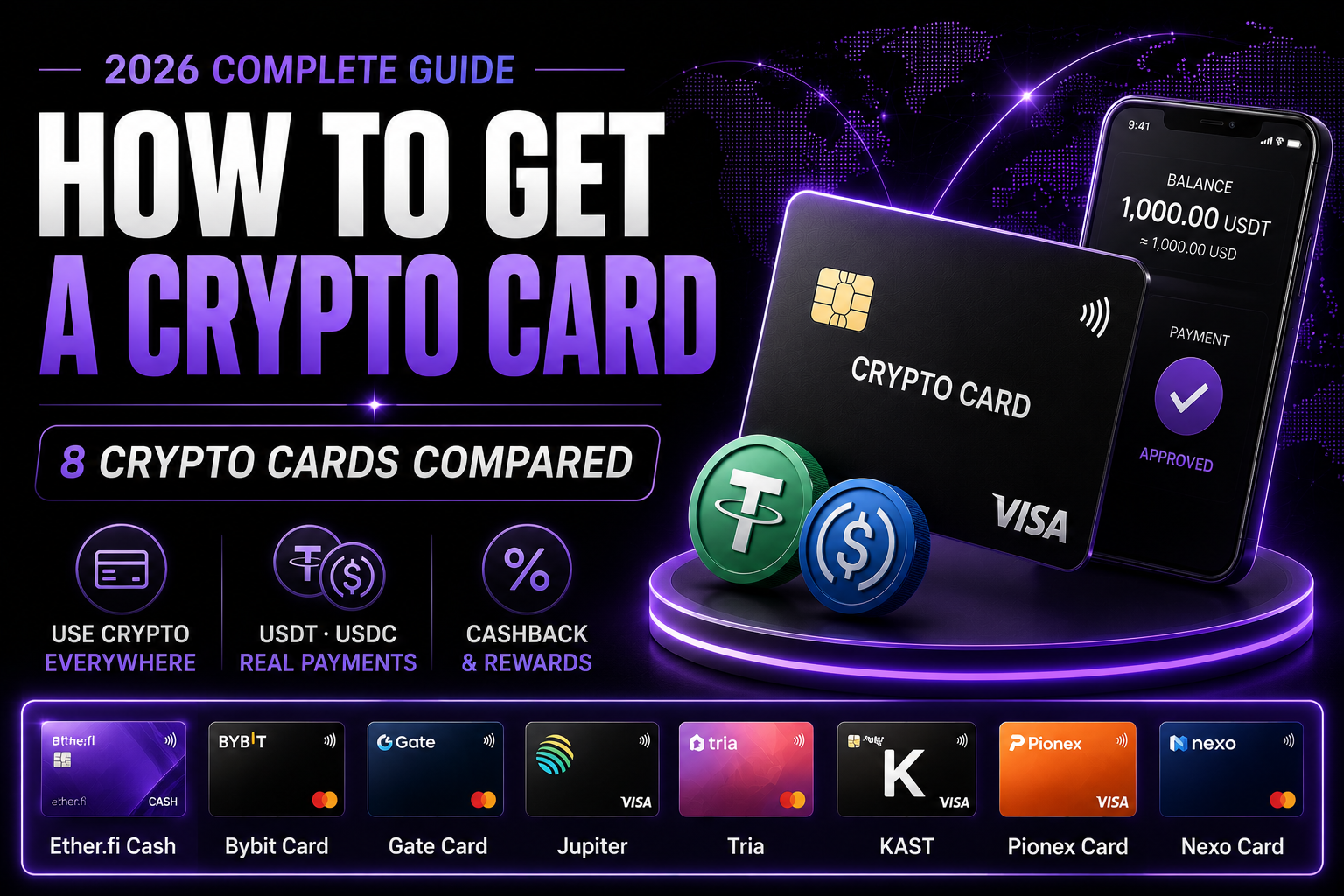
In this guide, we’ll explain how crypto cards work, how to get one, what to check before applying, and compare eight notable options:
Ether.fi Cash, Bybit Card, Gate Card, Jupiter, Tria, KAST, Pionex Card, and Nexo Card.
What Is a Crypto Card?
A crypto card is a payment card that connects cryptocurrency or stablecoin assets with traditional card payments.
Depending on the provider, you may be able to fund or use the card with assets such as USDT, USDC, ETH, or other supported cryptocurrencies.
The basic process can be summarized as:
Hold Crypto
↓
Apply for a Crypto Card
↓
Fund or Connect Your Balance
↓
Pay at Supported Merchants
The exact mechanism differs by provider.
Some cards are closely integrated with centralized exchanges. Others focus on stablecoins, Web3 wallets, or DeFi.
This is why choosing a crypto card based only on its name or card design isn't a great idea.
You should first determine which assets you hold, where you live, and how you intend to use the card.
How Do You Get a Crypto Card?
The application process varies, but most crypto cards follow a similar structure.
Step 1. Choose a crypto card provider
Start by comparing providers based on your country, supported cryptocurrencies, fees, rewards, and intended use.
Step 2. Create an account
Register with the selected platform.
Step 3. Complete KYC if required
Depending on the card and jurisdiction, identity verification may include a passport or government-issued ID, selfie verification, address information, or other documentation.
Step 4. Apply for the card
Depending on the provider, a virtual card, physical card, or both may be available.
Step 5. Fund or connect the card
Prepare a supported asset such as USDT or USDC and follow the provider's funding instructions.
Step 6. Make a small test payment
Before moving a large amount of crypto, it's sensible to test the entire process with a small deposit and purchase.
One important distinction:
Being able to open an account with a crypto platform does not necessarily mean you are eligible for its card.
Card availability can depend on your country of residence and the issuer's policies.
8 Crypto Cards to Compare in 2026
There isn't one crypto card that is automatically best for everyone.
A better approach is to match the card to the way you already use crypto.
| Crypto Card | Main Focus | Best Suited For |
|---|---|---|
| Ether.fi Cash | DeFi + card rewards | Everyday spending & rewards |
| Bybit Card | Exchange integration | Existing Bybit users |
| Gate Card | Gate ecosystem | Existing Gate users |
| Jupiter | Solana ecosystem | Solana users |
| Tria | Web3 / multichain | Multichain users |
| KAST | Stablecoin-focused services | USDT & USDC users |
| Pionex Card | Exchange integration | Pionex users |
| Nexo Card | Crypto financial services | Existing Nexo users |
Availability, fees, rewards, supported assets, and eligibility can change. Always verify the current terms before applying.
1. Ether.fi Cash — For Everyday Spending and Rewards
Ether.fi Cash is one of the first options worth comparing if your priority is actually using a crypto card rather than simply owning one.
Ether.fi is widely associated with the Ethereum and DeFi ecosystem, while Cash extends the ecosystem toward real-world payments.
One of its biggest attractions is its cashback structure.
Depending on current terms and eligibility, Ether.fi Cash can offer cashback of up to around 3%, making it particularly interesting for users with meaningful monthly card spending.
This distinction matters.
If you're only going to use a crypto card once or twice, a small difference in issuance fees might matter more.
If you're planning to use the card regularly, however, ongoing fees and rewards can become much more important than the initial card cost.
Who should consider Ether.fi Cash?
- People planning to use a crypto card regularly
- Users who value cashback
- DeFi users looking for real-world payment functionality
- Users who don't necessarily want a card tied solely to a centralized exchange
Check Ether.fi Cash and apply here:
2. Bybit Card — Convenient for Existing Bybit Users
If you already use Bybit, Bybit Card can be a natural option to investigate.
The appeal of an exchange-linked card is straightforward: instead of opening another completely separate crypto service, existing users may be able to keep more of their activity within the same ecosystem.
This can make account and asset management more convenient.
However, there is an important distinction between access to the Bybit exchange and eligibility for Bybit Card.
Card availability is region-dependent, so always check whether the card is currently available in your country of residence.
3. Gate Card — For Existing Gate Users
The same logic applies to Gate Card.
If you already keep assets or trade through Gate, its card offering may be more convenient than transferring assets to an entirely separate provider.
For someone who doesn't use Gate, however, the comparison changes.
Instead of choosing the card simply because it comes from a major exchange, compare its total costs, supported assets, regional availability, and rewards against independent crypto-card services.
4. Jupiter — Worth Watching for Solana Users
If most of your crypto activity happens on Solana rather than Ethereum or centralized exchanges, Jupiter is particularly relevant.
Jupiter is a major part of the Solana ecosystem, so users holding SOL or interacting frequently with Solana-based assets may find its payment ecosystem more aligned with how they already use crypto.
This highlights an important principle when choosing a crypto card:
The closer the card is to the ecosystem where you already hold and use your assets, the fewer unnecessary transfers and conversions you may need.
5. Tria — For Web3 and Multichain Users
Not everyone keeps all of their assets on one exchange or blockchain.
If you regularly move between different wallets, chains, and Web3 applications, Tria is another option to compare.
For multichain users, the card issuance fee shouldn't be the only consideration.
Look at the entire route from your assets to the final payment:
Supported chains → Supported assets → Conversion process → Card payment → Total cost
If you have to bridge and swap assets multiple times before spending them, a seemingly inexpensive crypto card can become less convenient.
6. KAST — For Stablecoin-Focused Users
Many people looking for a crypto card aren't necessarily trying to spend Bitcoin.
Instead, they hold USDT or USDC and want a practical way to connect dollar-denominated stablecoins with everyday payments.
That's where a stablecoin-focused service such as KAST becomes interesting.
If stablecoins make up most of the balance you intend to spend, focus on factors such as supported stablecoins, funding methods, foreign exchange costs, payment availability, and regional restrictions.
7. Pionex Card — For Existing Pionex Users
If Pionex is already part of your crypto setup, Pionex Card may be another logical option.
As with other exchange-linked cards, convenience is a major consideration.
Existing users may prefer connecting payments to a platform they already use rather than opening and funding another account.
If you're not currently a Pionex user, compare the card on its own merits before deciding whether opening another exchange account makes sense.
8. Nexo Card — Crypto Finance and Payments Combined
Nexo Card is slightly different from looking at a simple crypto-funded prepaid card in isolation.
Nexo offers a broader crypto financial ecosystem, so its card is especially relevant to people who already use or intend to use other Nexo services.
For an existing Nexo customer, having crypto financial services and card functionality within the same ecosystem can be attractive.
For everyone else, compare the full service structure rather than evaluating the card solely by its branding.
Don't Compare Crypto Cards by Issuance Fee Alone
This is one of the most important points in this guide.
The cheapest crypto card to obtain is not necessarily the cheapest crypto card to use.
Imagine two cards:
Card A is free to issue.
Card B costs $50.
At first glance, Card A looks like the obvious winner.
But what if Card A repeatedly charges higher funding or conversion fees while Card B has lower ongoing costs and offers cashback?
For someone spending thousands of dollars over time, Card B could ultimately be the less expensive option.
A more useful way to think about crypto-card costs is:
Issuance Fee + Funding Costs + Payment Fees + FX Costs − Cashback & Rewards
The more you spend, the more important the recurring parts of this equation become.
7 Things to Check Before Getting a Crypto Card
1. Is the card available in your country?
This should be the first check. Platform availability and card eligibility are not necessarily the same.
2. Which cryptocurrencies are supported?
Check whether the provider supports the assets you actually hold, such as USDT, USDC, BTC, or ETH.
3. Is KYC required?
Depending on the provider and jurisdiction, identity verification may be required.
4. What are the real fees?
Look beyond issuance fees. Check funding, spending, ATM, foreign exchange, and cross-border fees.
5. How does cashback work?
A headline cashback percentage doesn't tell the whole story. Check caps, eligibility requirements, exclusions, and how rewards are paid.
6. Does it support Apple Pay or Google Pay?
Mobile-wallet compatibility matters if you want to use your phone for contactless payments.
7. What are the spending and funding limits?
Daily and monthly limits become increasingly important for higher-volume users.
Which Crypto Card Should You Choose?
Rather than looking for a universal winner, start with your use case.
Everyday spending + cashback
→ Ether.fi Cash
Already using Bybit
→ Bybit Card
Already using Gate
→ Gate Card
Solana-focused
→ Jupiter
Web3 and multichain activity
→ Tria
Stablecoin-focused
→ KAST
Existing Pionex user
→ Pionex Card
Crypto financial services + card
→ Nexo Card
If you can complete KYC and your priority is real-world spending combined with card rewards, Ether.fi Cash is one of the first options I'd compare.
Where Can You Compare Crypto Cards?
Crypto-card conditions can change quickly.
A provider may change its supported countries, card issuer, fees, rewards, KYC requirements, or supported assets.
The frustrating part is that this information is often scattered across multiple websites.
CryptoCard.Life organizes crypto-card information in one place, including card comparisons, application guides, KYC options, stablecoin cards, and individual card features.