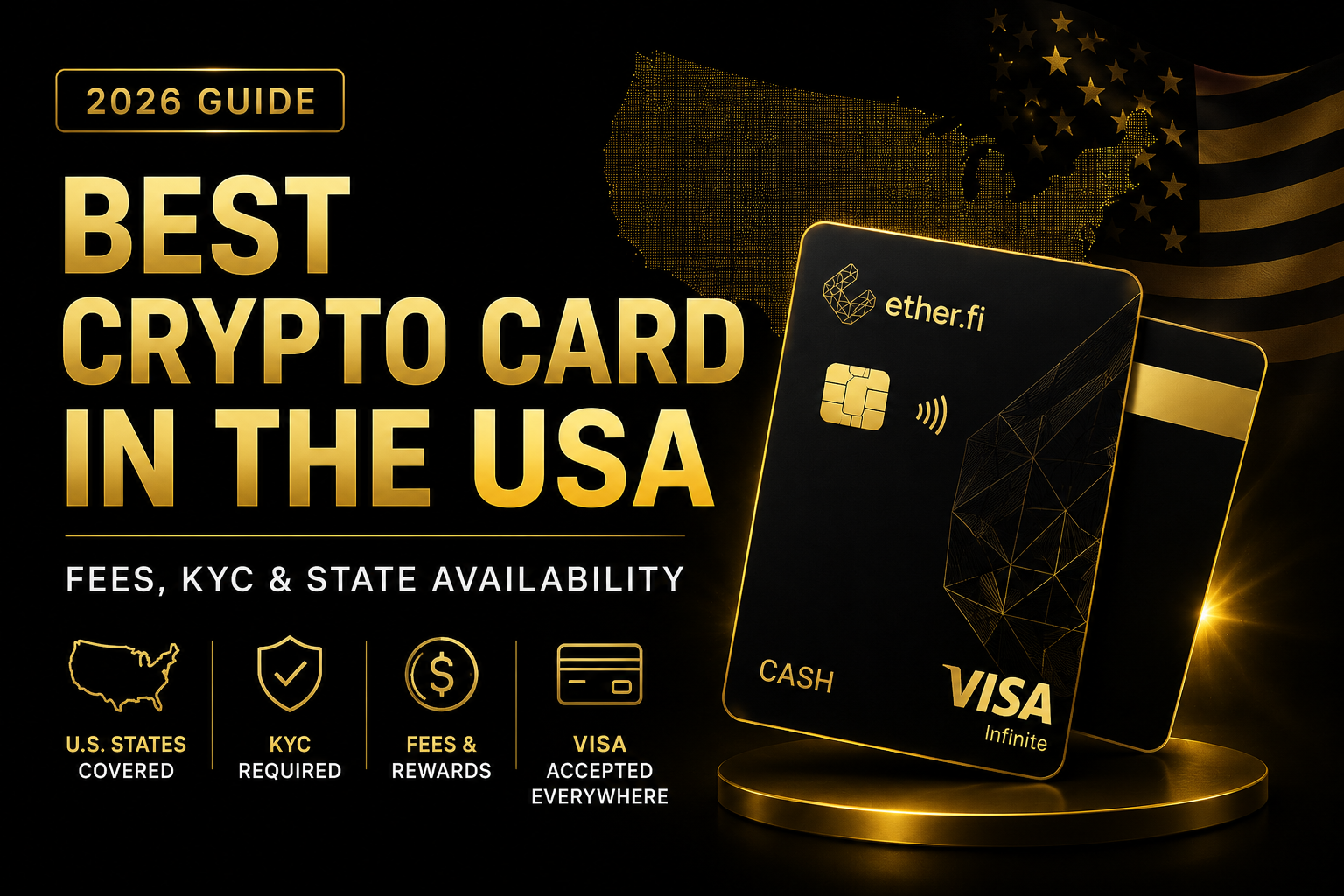
Crypto cards are becoming a practical way to connect digital assets with everyday spending.
But if you live in the United States, choosing a crypto card isn't as simple as finding the card with the highest advertised rewards.
The U.S. market has one major complication:
Card availability can vary by state.
A crypto card may be available to residents of California or Texas while being unavailable to someone living in Washington or Ohio.
That makes state eligibility, KYC, fees, card structure, and spending mechanics just as important as rewards.
This guide explains what U.S. users should check before applying for a crypto card in 2026 — and why Ether.fi Cash is one option worth examining.
💡 Quick Answer
The best crypto card for a U.S. user depends first on whether the card is available in your state.
Before comparing rewards, check state eligibility, KYC requirements, fees, supported assets, and how your crypto is actually used when you spend.
What Is a Crypto Card?
A crypto card connects digital assets or a crypto-based account with a traditional payment network.
Depending on the product, you may be able to use assets such as:
The merchant typically doesn't need to accept cryptocurrency directly.
Instead, the card provider handles the payment infrastructure while the purchase is processed through a traditional card network.
This is an important distinction.
Using a crypto card at a coffee shop does not necessarily mean the coffee shop is accepting an on-chain crypto payment.
Crypto Debit Card vs. Crypto Credit Card
Not every crypto card works the same way.
One of the first things U.S. users should understand is whether they're looking at a debit, prepaid, or credit-based product.
| Type | How It Generally Works | What to Check |
|---|---|---|
| Crypto debit card | Uses funded assets or balance | Conversion and spending fees |
| Prepaid crypto card | Spend from a funded card balance | Reload and funding rules |
| Crypto credit card | Uses a credit structure | Collateral, repayment and eligibility |
| Rewards card | Earns crypto from purchases | Reward rate and limits |
This distinction matters because two cards can both be called “crypto cards” while having completely different spending mechanics.
What U.S. Users Should Check First
Before comparing cashback percentages, start with the basics.
For U.S. residents, state availability should usually be the first filter.
If your state isn't supported, the rest of the card's features don't matter.
Are Crypto Cards Available in the USA?
Yes, several crypto card products serve U.S. residents.
However, availability isn't always nationwide.
Regulatory and operational requirements can cause card programs to support some states while excluding others.
Ether.fi Cash is a good example.
According to Ether.fi's current official availability information, Cash is available in many U.S. states, but not every state is supported.
Why Ether.fi Cash Is Different From a Typical Crypto Debit Card
Ether.fi Cash is worth understanding because it isn't simply another conventional prepaid crypto card.
The product is built around a crypto-backed spending model and Ether.fi's broader on-chain account infrastructure.
Ether.fi says its Cash card can be used anywhere Visa cards are supported.
This gives users a familiar payment experience while connecting spending with crypto-native infrastructure.
Does Ether.fi Cash Require KYC?
Yes.
This is particularly important for users searching for phrases such as “no KYC crypto card.”
Ether.fi states that identity verification is required to use its Cash card and fiat services.
The KYC process can include:
Accepted identity documents can include a passport, national ID card, or driver's license.
Approval is required before a Cash card can be issued.
For U.S. users, this means Ether.fi Cash should be viewed as a regulated card product with identity and eligibility requirements — not an anonymous spending card.
Virtual vs. Physical Crypto Cards
Another important decision is whether you actually need a physical card.
| Feature | Virtual Card | Physical Card |
|---|---|---|
| Online purchases | Yes | Yes |
| Immediate access | Typically faster | Requires delivery |
| Physical wallet | No | Yes |
| Shipping required | No | Yes |
| In-store use | Wallet-dependent | Direct card use |
Ether.fi says its virtual card becomes available for use once the relevant setup is completed.
Physical card availability depends on your jurisdiction and eligibility.
If most of your spending happens online, a virtual card may be enough.
If you frequently make in-person purchases, physical card availability becomes more important.
Can You Use a Crypto Card Anywhere?
Not literally everywhere.
However, cards connected to major payment networks can generally be used wherever that network is accepted, subject to the provider's restrictions.
Ether.fi states that Cash can be used anywhere Visa cards are supported.
That means the merchant doesn't need special crypto payment infrastructure.
From the merchant's perspective, the transaction functions through the card network.
What About Crypto Card Fees?
Fees can make a significant difference in the real value of a crypto card.
Don't evaluate a card based only on its advertised rewards.
Check for:
Ether.fi's current personal Cash card documentation says added FX fees vary by membership level.
Its Core tier lists an added FX fee of 0–0.5%, while higher membership levels can have lower or no added FX fee.
These details can change, so always check the latest fee schedule before using a card for significant spending.
A 3% Reward Doesn't Always Mean a 3% Gain
This is one of the easiest mistakes to make when comparing crypto cards.
Imagine two cards.
| Card | Advertised Reward | Effective Costs | Simplified Net Value |
|---|---|---|---|
| Card A | 5% | 3% | 2% |
| Card B | 3% | 0.5% | 2.5% |
This is only an illustrative example, but it demonstrates an important point.
Higher advertised rewards don't automatically produce better real-world value.
You should compare what you actually receive after applicable fees, limits, membership requirements, and other costs.
Crypto Card Rewards: Read the Conditions
Rewards are another area where headline numbers can be misleading.
A card may advertise an attractive cashback rate while imposing:
- spending-category restrictions,
- monthly reward caps,
- membership requirements,
- minimum balances,
- excluded transactions,
- or different reward tiers.
Ether.fi's current Cash benefits vary according to Club membership level.
Therefore, U.S. users should check the reward level they actually qualify for rather than assuming the highest advertised benefit applies automatically.
Can You Spend USDT With a Crypto Card?
Some crypto cards are designed around stablecoin spending or allow supported crypto assets to fund purchases.
USDT and USDC are especially relevant because they're designed to track the value of the U.S. dollar.
But “supports USDT” does not always mean a merchant directly receives USDT.
The provider may convert or otherwise process the value as part of the card transaction.
Always check how funding, conversion, settlement, and fees work for the specific card you're considering.
What About Taxes When Spending Crypto in the U.S.?
U.S. users should also consider tax implications.
Crypto card spending can have different tax consequences depending on how the product works.
For example, a product that sells or converts cryptocurrency to fund a purchase can create a different tax situation from a conventional dollar credit transaction that simply pays rewards in crypto.
The exact treatment depends on your circumstances and the card structure.
Keep transaction records and consult a qualified U.S. tax professional if you're unsure how your crypto card activity should be reported.
⚠️ Important
CryptoCard.Life provides informational comparisons, not tax or legal advice.
U.S. cryptocurrency tax rules can depend on the transaction and individual circumstances.
How to Choose a Crypto Card in the USA
A simple way to compare cards is to work through the decision in this order.
This prevents a common mistake:
Choosing a card because of a high reward rate before discovering that the card isn't available in your state or doesn't fit the way you hold and spend crypto.
Who Should Consider Ether.fi Cash?
Ether.fi Cash may be worth considering if you:
- live in a supported U.S. state,
- already use crypto or on-chain assets,
- want access to a Visa card,
- are comfortable completing KYC,
- and prefer a crypto-backed card structure.
It may be less suitable if your state isn't supported or if you're specifically looking for a no-KYC product.
Frequently Asked Questions
What is the best crypto card in the USA?
There is no single best crypto card for every U.S. resident. The right choice depends on state availability, card type, fees, rewards, KYC requirements, and how you want to use your crypto.
Are crypto cards legal in the United States?
Crypto card products operate in the United States subject to applicable financial, card-network, compliance, and state requirements. Availability varies by provider and can also vary by state.
Is Ether.fi Cash available in the United States?
Yes, Ether.fi Cash is currently available in many U.S. states, but not nationwide. Check the latest official state availability before applying.
Is Ether.fi Cash available in New York?
Ether.fi's current Cash card availability list includes New York. Product-specific eligibility requirements still apply.
Is Ether.fi Cash available in California?
California is currently included in Ether.fi's supported U.S. state list.
Is Ether.fi Cash available in Texas?
Texas is currently included in Ether.fi's supported U.S. state list.
Does Ether.fi Cash require KYC?
Yes. Ether.fi states that identity verification is required for Cash card and fiat services, and approval is required before a card can be issued.
Can I get a crypto card without KYC in the USA?
You may find products marketed as no-KYC cards, but users should be cautious about availability, issuer structure, compliance, consumer protections, and whether the product explicitly supports U.S. residents.
Can I use a crypto card for everyday purchases?
Depending on the card and merchant, yes. Ether.fi says its Cash card can be used anywhere Visa cards are supported, subject to applicable restrictions.
Should I choose the crypto card with the highest cashback?
Not necessarily. Compare the reward you can actually earn after fees, limits, membership requirements, and eligibility conditions.
Final Takeaway
For U.S. residents, finding the best crypto card in 2026 starts with one question:
Is the card actually available in my state?
After that, compare KYC, card structure, supported assets, fees, spending mechanics, and realistic rewards.
Ether.fi Cash stands out as an option for crypto-native users in supported U.S. states who want to connect on-chain assets with everyday Visa spending.
Just remember that eligibility is state-dependent and card terms can change.
Always check the latest requirements before applying.